

A while ago, I was bored and wrote a Twitter post on how to find an integer if you only know the fractional part of its square root. My Twitter is private these days, and lies unused, but I still get questions about this topic from time to time, so I decided to put it into a blog post on here.
Why would one care about reconstructing an integer from the fractional part of its square root you might ask? It turns out there is some crank out there who claims that this can serve as the basis for his brilliant crypto system, so showing that this reconstruction is possible is the same as a key recovery attack.
Computing Square Roots
As usual with crank cryptography, the official documents are very light on actual description of the algorithm, so we will have to nail down the definitions first before we can actually attack the cryptosystem.
From what can be inferred from the documents, we first select a secret


Before we look at the security of this algorithm, lets first take a quick glance at how it otherwise works for a DRBG. The best algorithm to compute a square root is using Newton’s method to first compute the inverse square root, and then recover the square root via multiplication with the number itself. In other words, apply Newton’s method to the function


For Newton’s method we need to first compute the derivative of our function, which is just


Newton’s iteration then gives us:


Now we can see why we prefer to compute the inverse square root with the iteration: The formula happens to only ever divide by 2, so it is far cheaper then having to divide by


Quadratic convergence means we roughly double the number of correct digits each iteration step, but looking at our iteration step, we need to multiply several


This is abysmal. A DRBG should have linear time complexity and constant space complexity, i.e. the cost of producing an extra bit of randomness should not depend on how much randomness was previously created. It seems like even our crank caught wind of that, because he used this generator just to seed a Blum-Blum-Shub generator, which, while one of the slowest DRBGs we have, has linear time complexity and constant space complexity. You can also add a backdoor to it, which I guess is a property you can have in a DRBG, if you like it.
Lattices enter Stage left
With the ranting about how badly this DRBG performs aside, to the main piece of this article, how to break it. We will use a well-known technique to tackle Diophantine equations with some lattice math for this.
For this, let’s get some


![\alpha = \sqrt{a}-\lfloor\sqrt{a}\rfloor\in[0, 1]](https://s0.wp.com/latex.php?latex=%5Calpha+%3D+%5Csqrt%7Ba%7D-%5Clfloor%5Csqrt%7Ba%7D%5Crfloor%5Cin%5B0%2C+1%5D&bg=ffffff&fg=000&s=0&c=20201002)




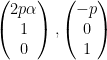
In other words, the elements of our lattice are the vectors of


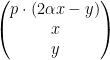


In other words, if we find the lattice vector closest to


But wait, I hear you say, isn’t that the Closest Vector Problem (CVP), known for being hard to compute. Well indeed it is. And it is hard to compute. For higher dimensional lattices. For a rank 2 lattice embedded in three dimensions, it’s not. You simply reduce the lattice basis above, express


Lattice reduction for two dimensional lattices is incredibly fast, resulting in an algorithm that is nearly as fast to break as it is to compute in the first place. The author of the algorithm suggested a hardening technique of varying the offset used, i.e. discarding some of the keystream. This of course doesn’t do anything, as the attack is fast enough, and the computation of the keystream is slow enough, that you can simply bruteforce all possible starting points, changing
While this algorithm is obviously bogus for cryptographic purposes, the general technique for solving Diophantine equations with lattices is a useful tool to understand and study, similar techniques are for example used in Coppersmith’s attack on RSA with small exponents and are valuable to understand for anyone with an interest in discrete mathematics.